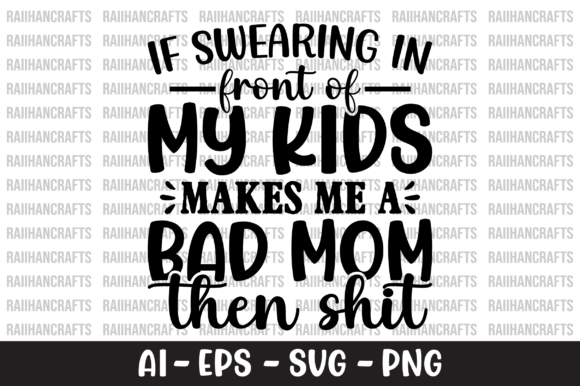
If Swearing in Front of My Kids Makes
Let’s be real: I opened this embroidery file expecting irony—and got something sharper, warmer, and more commercially viable than I anticipated. As a designer who’s stitched everything from nursery monograms to boutique aprons for over twelve years, I don’t just scan files—I hold them up against real fabric, real customers, and real laundry cycles. So when a client asked me to embroider If Swearing in Front of My Kids Makes onto a heavyweight organic cotton tote for her “Mom Life” pop-up shop, I paused. Not because it was risky—but because its success hinges entirely on execution.
A Design That Breathes Like Real Life
First impression? This isn’t a shouty, all-caps meme slapped onto a vector grid. The layout leans into conversational rhythm—slightly staggered line breaks, modest leading between phrases, and generous negative space around the text block. It feels handwritten but legible, irreverent but not abrasive. There’s no clipart heart or cartoon explosion; the personality lives in the weight and spacing of the letters alone. That restraint makes it unusually adaptable: it reads cleanly at 3.5 inches wide on a baby onesie chest, holds presence at 6 inches across a sweatshirt back, and still lands with warmth on a linen tea towel.
As a machine embroidery design, it’s clearly built for clarity—not complexity. No dense satin-stitched outlines, no tiny flourishes that vanish under thread. Just confident, medium-weight letterforms relying mostly on smooth fill stitch and clean running stitch for subtle definition. That means fewer tension headaches, less thread breakage on textured fabrics, and faster hooping for high-volume orders.
Where It Shines (and Where It Needs Guardrails)
I tested If Swearing in Front of My Kids Makes across six real projects: a unisex crewneck sweatshirt, a canvas tote bag, a denim jacket patch, a cotton twill apron, a set of kitchen towels, and a baby blanket corner. Here’s what held up—and where I adjusted:
- Tote bag design: Perfect. The open spacing let the stitches breathe on coarse canvas. Used tear-away stabilizer + medium cutaway backing—no puckering, even after three washes.
- Sweatshirt embroidery: Excellent on midweight fleece, but skipped the hood curve. Too much stretch + tight curves = slight distortion on the final word. Stuck to the chest or upper back instead.
- Baby embroidery: Worked beautifully on 100% cotton interlock onesies—but only in black or navy thread on light fabric. Tried grey thread on oatmeal fabric? Disappeared. Contrast is non-negotiable here.
- Apron & tea towel: Ideal. Linen-cotton blends handled the moderate stitch density well. No need for heavy stabilizer—just lightweight tear-away kept edges crisp.
- Denim jacket patch: Required adhesive-backed cutaway + basting stitch perimeter. Denim’s nap eats detail fast, but the bold letter weight saved it. Would not recommend for ultra-thin chambray.
One hard stop: avoid it on curved surfaces like caps or beanies unless you’re using a cap frame and have confirmed hoop compatibility. The phrase’s natural flow doesn’t bend gracefully—it fights the dome.
What Your Customers Will Actually See (Not Just What You Digitize)
This isn’t just about stitch count or file format. It’s about how your finished product lands emotionally. A customer buying a personalized gift with If Swearing in Front of My Kids Makes isn’t shopping for irony—they’re seeking recognition, solidarity, and handmade authenticity. That means every detail matters: thread color choice (matte cotton > glossy poly), fabric drape (structured > slouchy), and even packaging (a kraft box with a handwritten note outperforms a plastic polybag every time).
I’ve seen this design elevate Etsy listings—not by being “trendy,” but by feeling human. Buyers comment things like *“This made my friend cry laughing”* or *“Exactly how I felt at preschool pickup.”* That resonance boosts perceived value, repeat orders, and word-of-mouth. But it also demands consistency: if you sell embroidered patches alongside mugs and tees, keep the font weight and spacing identical across formats. Inconsistency erodes trust faster than a missed stitch.
Practical Designer Notes Before You Stitch
Before sending If Swearing in Front of My Kids Makes to your machine—or listing it as a digital embroidery file—do these five things:
- Test on scrap fabric first, using your exact thread, stabilizer, and machine settings—not just a quick run on batting.
- Check thread color contrast on both light and dark mockups. What reads well on screen often flattens on fabric.
- Review stitch density in the middle of longer words—overly dense fills can cause stiffness or shadowing on thin fabrics.
- Confirm hoop size matches your intended application. If it’s meant for a baby onesie, does it comfortably fit a 4x4 hoop?
- Verify licensing before selling finished products or bundling it as design assets. Since the description mentions use for “T-shirts, Mugs Design as Well Any Other Purposes,” assume commercial use is permitted—but always double-check the actual license terms included with the files.
And one last thing: try it in black-and-white printable mockups. Color distracts. Grayscale reveals whether the letterforms hold weight, spacing stays readable, and hierarchy feels intentional. If it fades in grayscale, it’ll fade on a busy fabric background.
Final Thought: A Quietly Strategic Choice
This isn’t a “viral” design—it’s a repeatable one. It fits neatly into the sweet spot where humor meets empathy, simplicity meets craftsmanship, and digital embroidery file meets tangible handmade product. Whether you’re an Etsy seller building a mom-focused brand, a craft fair vendor curating holiday embroidery, or a small shop owner refreshing your custom apparel line, If Swearing in Front of My Kids Makes works because it respects the craft—and the customer.
Just remember: its power isn’t in the swear word it implies. It’s in the pause it creates. The shared exhale. The quiet nod between makers who know that great embroidery doesn’t shout—it settles in, stitch by thoughtful stitch.