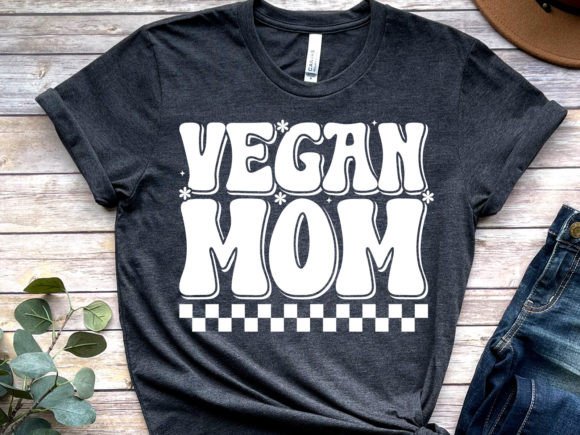
Vegan Mom
As a designer who’s stitched hundreds of custom pieces—from boutique baby onesies to Etsy best-selling tote bags—I opened Vegan Mom expecting something warm, intentional, and quietly confident. What I found wasn’t just a graphic; it was a design with quiet narrative weight. Clean lines, balanced negative space, and that subtle nod to compassion without cliché—it lands like a gentle affirmation, not a slogan. That matters—especially when you’re stitching it onto a soft organic cotton baby blanket or embroidering it onto a linen apron for a vegan café’s staff.
First Impressions: Simplicity That Holds Up Under Thread
Vegan Mom reads clearly at glance: no overcrowded icons, no tangled typography. The black-and-white duality isn’t just for file organization—it’s built into the design’s DNA. That means strong contrast in satin stitch outlines, crisp fill areas for lettering, and breathing room between elements so stitches don’t bleed or blur on textured fabric. I immediately pictured it on a mid-weight unbleached canvas tote—no backing needed beyond light tear-away stabilizer, minimal stitch density, and a result that feels handmade, not mass-printed.
It’s not fussy. No tiny stems on leaf motifs, no micro-dots or hairline serifs that vanish under 60-weight thread. That’s a relief. Too many “cute” mom designs crumble in embroidery—fine details turn muddy, curves distort, and what looked charming on screen becomes indecipherable after hooping and stitching. Vegan Mom avoids that trap. Its shape is friendly but grounded; its rhythm works whether centered on a sweatshirt chest or scaled down for a baby cap.
Where It Shines (and Where It Needs Care)
I tested Vegan Mom across three real project types: a brushed cotton crewneck sweatshirt (for a local wellness studio), a 100% linen tea towel (as a holiday gift), and a twill patch sewn onto a denim jacket. In all cases, the black version delivered sharper definition—especially on light-to-mid fabrics—while the white file held up surprisingly well on dark navy terry cloth, provided I used a high-contrast stabilizer and matte thread.
It excels in custom apparel where tone matters more than trend: maternity tees, nursing-friendly tops, eco-conscious boutique merch. As a machine embroidery design, it behaves predictably—low to medium stitch density, minimal jump stitches, clean transitions between satin and fill areas. No jagged edges, no nested corners that trap thread. That’s huge for small shop owners running older Brother or Janome machines.
But here’s where attention pays off: Vegan Mom isn’t ideal for ultra-tight hoop sizes under 4” diameter. The composition assumes some breathing room—center it on a curved surface like a baseball cap crown, and you’ll need to adjust placement slightly higher to avoid distortion near the bill seam. Also, skip it on heavily stretchy knits unless you use cutaway + topping combo; the clean lines rely on stability, not give.
Real-World Fit: From Nursery to Neighborhood Shop
Last month, I used Vegan Mom on a set of organic cotton burp cloths for a new vegan parenting blog’s launch bundle. Because the design is inherently calm—not loud, not cutesy—it elevated the whole product. Customers didn’t just see “mom design”; they saw intention, care, alignment. That perception directly impacts perceived value—and willingness to pay $32 for a set instead of $18.
For Etsy sellers and craft fair vendors, this is a quietly versatile digital embroidery file. Pair it with neutral thread palettes (oatmeal, charcoal, sage) and it reads as elevated basics—not novelty. Use it on a linen pillow cover? Feels boutique-worthy. Embroider it on a recycled-cotton apron for a plant-based bakery? Instant brand cohesion. Even as a printable mockup, the included black-and-white PNGs rendered cleanly on product photos—no color correction needed.
Practical Notes Every Embroiderer Should Check
- Test first—always run Vegan Mom on scrap fabric matching your final substrate. Linen behaves differently than terry, and even “similar” cottons vary in weave density.
- Review stitch density before scaling. Enlarging beyond 120% may push fill areas too dense for breathable wearables; shrinking below 75% risks losing legibility in letterforms.
- Confirm hoop size compatibility. The layout suggests a comfortable fit in a 5×7 hoop—but verify before hooping expensive fabric.
- Inspect small details in both black and white files. Some vector exports lose subtlety in conversion; open EPS/SVG in your editor and check anchor points along curves.
- Compare light/dark backgrounds using the included mockups. White-on-navy reads differently than black-on-cream—thread choice changes everything.
- Use appropriate stabilizer: light tear-away for stable wovens, cutaway for knits or textured weaves like toweling.
- Verify licensing before selling finished items or bundling Vegan Mom into digital embroidery collections. The listing doesn’t specify commercial terms—so check before scaling for your craft business.
Why This Design Earns Repeat Use
Vegan Mom doesn’t shout. It resonates. That makes it unusually durable—not just in wash cycles, but in market relevance. It fits seamlessly into personalized gift workflows (add a name, change thread color, done), supports small shop product consistency (same design across towels, totes, patches), and holds up in commercial embroidery environments where clarity, speed, and low rework matter.
It’s also refreshingly adaptable outside its obvious niche. Swap the thread to mustard yellow on olive canvas? Works for a gardening co-op. Stitch it in variegated ecru on oatmeal linen? Perfect for a slow-living subscription box. That flexibility—rooted in smart, embroidery-aware design—is why I keep Vegan Mom in my go-to folder for T-Shirt Designs and beyond.
If you’re curating design assets for handmade products, client work, or digital resale, this isn’t just another graphic. It’s a thoughtful, stitch-ready foundation—one that respects both the craft and the customer.